History
Imperial stout can trace its roots back to 18th century England, where brewers created stouts for export. These beers needed more alcohol and hops to survive long journeys, especially those destined for the Baltic region and Russia.
The style typically has low to moderate levels of carbonation with huge roasted, chocolate and burnt malt flavors. Suggestions of dark fruit and flavors of higher alcohols are quite evident. Hop character can vary from none, to balanced, to aggressive.
The practice of aging these stouts in bourbon barrels is a recent innovation. Greg Hall of Goose Island Brewery in Chicago is credited with creating the first commercially available bourbon barrel-aged stout, Bourbon County, in 1992. This sparked a barrel aging movement within the craft beer scene, which would see brewers experimenting with many types of casks, spirits and finishes to enhance their beer.
While the concept of aging beer in barrels has a long history, the specific practice of double barrel aging, where beer is aged in two different types of barrels sequentially, is a more recent development as brewers sought to create increasingly complex and flavorful beers. By aging beer in a first barrel, such as a bourbon or whiskey barrel, it absorbs the wood's flavors and tannins. Subsequently, transferring the beer to a second barrel, like another whiskey or rum barrel, introduces additional layers of flavor and complexity.
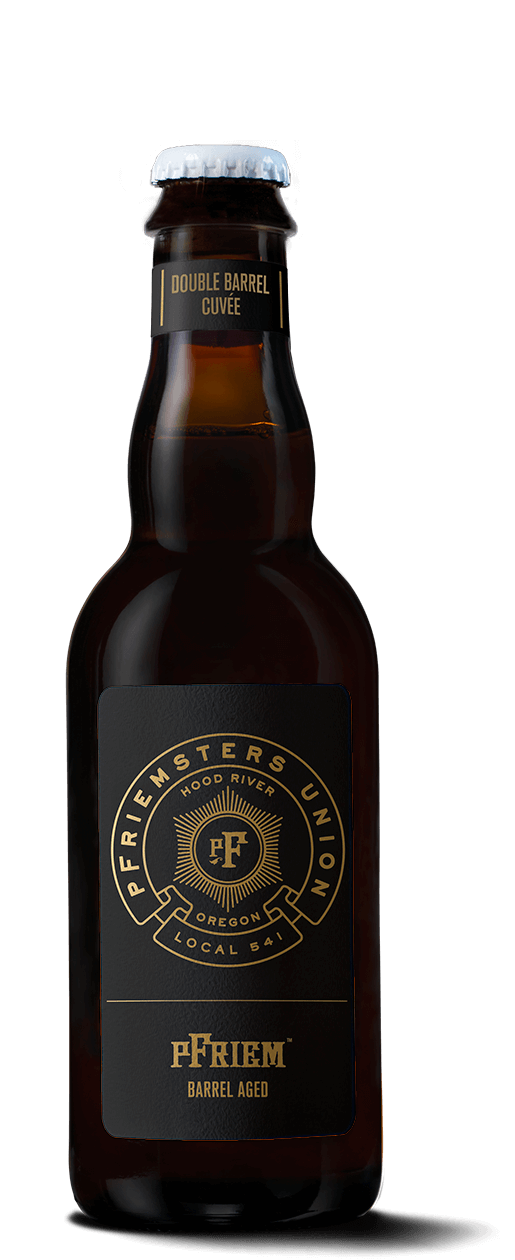
pFriem’s Double Barrel Cuvee began life as our brands Bourbon Barrel Imperial Stout, Rum Barrel Aged Porter and Rye Whiskey Imperial Brown. After aging for over a year in their respective casks, we then racked them into a second round of freshly emptied bourbon barrels, where they aged for an additional six months before blending and bottling.
Tasting Notes
This rich elixir pours dark and deep, fringed with crimson when the light hits just right, and rests under a veil of fine tan foam. Aromas of dark chocolate, silken vanilla and burnt toffee greet the imbiber. Upon sipping, notes of roast coffee and rich caramel reveal themselves, behind layers of cacao and oak. Lingering tannings and soft spirits reward those who savor the swallow.
Food Pairings
Charcuterie boards featuring aged cheeses like sharp cheddar or blue cheese, paired with cured meats such as salami or prosciutto, or maybe a creamy brie cheese with a drizzle of honey or fig jam. For main courses, a roasted root vegetable dish with a drizzle of maple syrup, a hearty beef stew or a grilled steak with a rich, peppery crust. On the sweeter side, consider a fruit tart or berry sorbet, a creamy caramel flan, decadent chocolate cake, or warm apple pie.