History
In order to understand the history of fruited Lambics, one must first understand the long, rich history of Lambic itself. A beer that we would likely recognize as Lambic was being lovingly produced in Belgium as early as the 12th century. In order to do so, the brewer, who was often also a farmer, built a mash consisting of 60% malted barley and 40% wheat. A minimum volume of aged hops was added to the boil solely for their preservative properties. Next the wort was transferred to a coolship, a long, wide and shallow vessel, designed, as the name implies, to cool the wort. In through the open windows, along with the chilly Belgian breeze, came magic. Soon, the wort began to bubble and foam, the result (we now know) of a mixed culture fermentation beginning. Finally, the slowly fermenting elixir was moved to oak barrels for maturation.
Adding fruit to traditionally produced Lambic is a significantly more recent development in brewing history, and likely began as a cottage industry. In fact, the first explicit mention we find of a cherry addition lies in the 1878 manuscript of a tenant farmer named Josse De Pauw from Schepdaal, Belgium. The fact that this tradition blossomed around the village of Schaarbeek outside Brussels is no accident as the cherries of the same name were once abundant in the area. And while cherries were likely the first fruit to be combined with Lambic, they were certainly not the last. The resultant beers have traditionally been named simply for the fruit included.
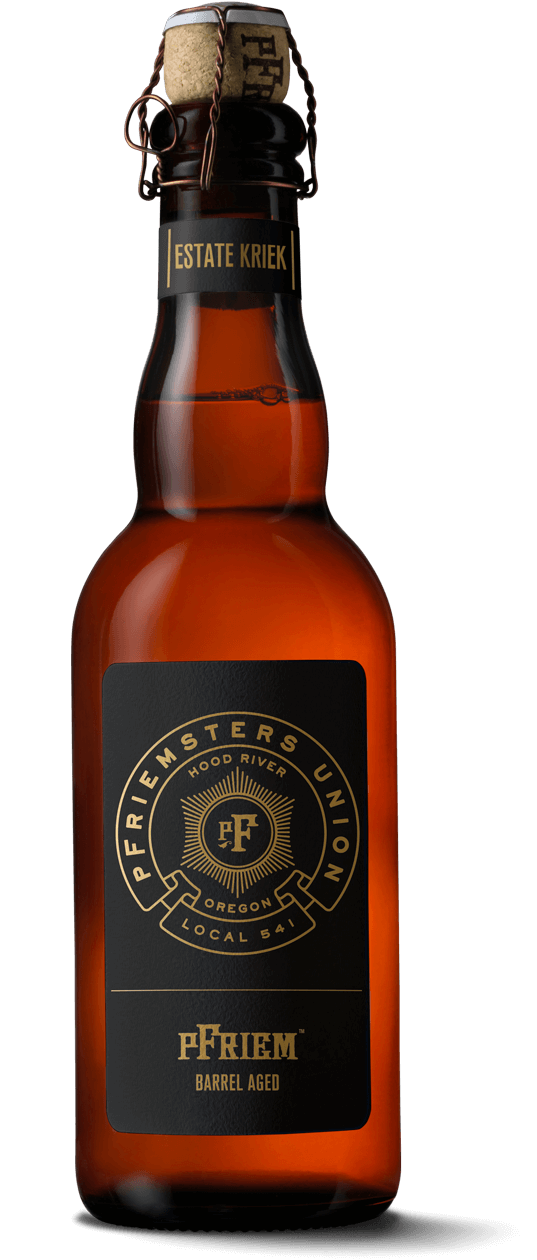
Estate Kriek is a unique offering as our cherry trees were planted for us in collaboration with Brian McCormick and Idiot’s Grace Vineyard and Orchard. Carmine Jewel cherries are known as a tart pie cherry, which contribute much less sugar but much more acid to the lambic blend. It originated as a cross between a sour cherry and a European dwarf cherry. As a “dwarf” variety, they only stand about 3-4 feet tall! While our regular Kriek uses sweet cherries to celebrate the heritage of the Pacific Northwest, using tart pie cherries in this was brings us closer to the Belgian tradition.
Tasting Notes
Soft pink color suggests the presence of fruit without overwhelm. The aroma presents graham cracker crust, almost flaky pastry, and subtle cherry – bright and alive. The palate opens with balanced acidity and notes of rose water, lilac, and a touch of funk. Finishes bright and tart but doesn’t linger or pucker.
Food Pairings
Caved aged cheeses, crusty olive bread, goat cheese, smoky poultry, poultry meatballs with a yogurt sauce, French almond pastries.