Beer was more discovered than invented, at least 3,900 years ago, by the ancient Sumerians who called the Fertile Crescent home. Ever since, Brettanomyces has played a significant role in both the history and the evolution of the World’s preferred alcoholic beverage.
For centuries, a myriad of cultures would thank various Deities for their version of the ethereal elixir. While we may never know whether the likes of Ninkasi, Aegir, or Radgest played a role in its creation, for most of what we do know regarding the basics of fermentation we have a French Microbiologist and a Danish brewery to thank. Louis Pasteur worked with the Carlsberg Brewery team to isolate microbes found in their pale lager. They were the first to identify the diverse bouquet of microflora that had always taken part in fermentation, and to determine that the process could be drastically altered based on which microbes were allowed to take part. From this research Sacchromyces Carlsbergensis was isolated, and as the industrial revolution swept the planet, so did “clean” Lagers and Ales.
The Belgians, however, willfully ignored the microbiological discoveries of the time and continued to pass their brewing knowledge verbally from parent to progeny, and from monk to monk, as they had for centuries. They regarded their resident microflora with reverence, and became Masters of managing their microbiological terroir, leading to the production of some of the most intriguing and sought after beers in the world.
Brettanomyces is referred to as a “wild” yeast for a number of reasons, but perhaps most importantly because it can produce an incredibly diverse range of flavors and aromas. There are innumerable strains that may remind us of a sweaty horse blanket, a failing goat, or a humid barnyard. Others may call to mind a smoky campfire, a fresh ground clove or a band aid. Still others, and those to which we at pFriem have developed a particular affinity, boast tropical fruit, citrus and a pleasantly assertive minerality.
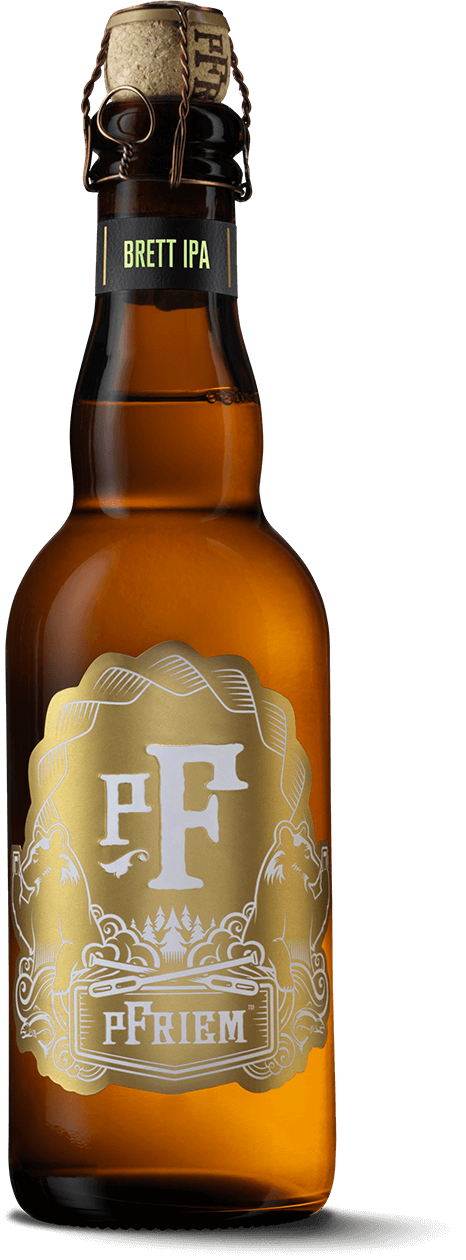
pFriem Brett IPA has a hop forward IPA as its base beer. We brewed this IPA with juicy, topical, and lemony hops creating a very aromatic beer. At bottling we added Brett Trois creating a secondary fermentation that enhances the fruity and tropical character of the beer. The Brett also enhances the floral nature of the beer as well. When this beer is young the hop flavor will be bright and vibrant and over time it will become funky